Where does it get stuck?
First we look for the source of the problem: calculation, overview, definitions, notation, proof structure or exam technique.
Mathematics, physics and STEM subjects

Some people learn a trick. I try to help you understand why it works.
For pupils and students: from Dutch Wiskunde B/D, physics and exam preparation to service mathematics in STEM degrees and the first abstract university mathematics courses. Calm, precise and without false understanding.
Can you think in four dimensions? The small panels first show how a sphere passes through a lower-dimensional space; the cross-section grows according to the same radius law.
Approach
First we look for the source of the problem: calculation, overview, definitions, notation, proof structure or exam technique.
A formula, physics question, linear map or limit should not only be formally correct; it should become imaginable.
The goal is not just to copy an example, but to see which definition, formula or strategy fits a new exercise.
Subjects and levels
From secondary-school material to the mathematical layer of a STEM degree and a range of undergraduate courses. This is the core of my current scope; for advanced courses, we first agree on the relevant topics and level.
For Mathematics students and courses in programmes including Physics, Astronomy, Life Science & Technology and Biomedical Sciences.
"From exam exercise to Algebra I: first the words and symbols have to become clear."
That is why the explanation can stay practical while still taking the underlying ideas seriously.
Profile
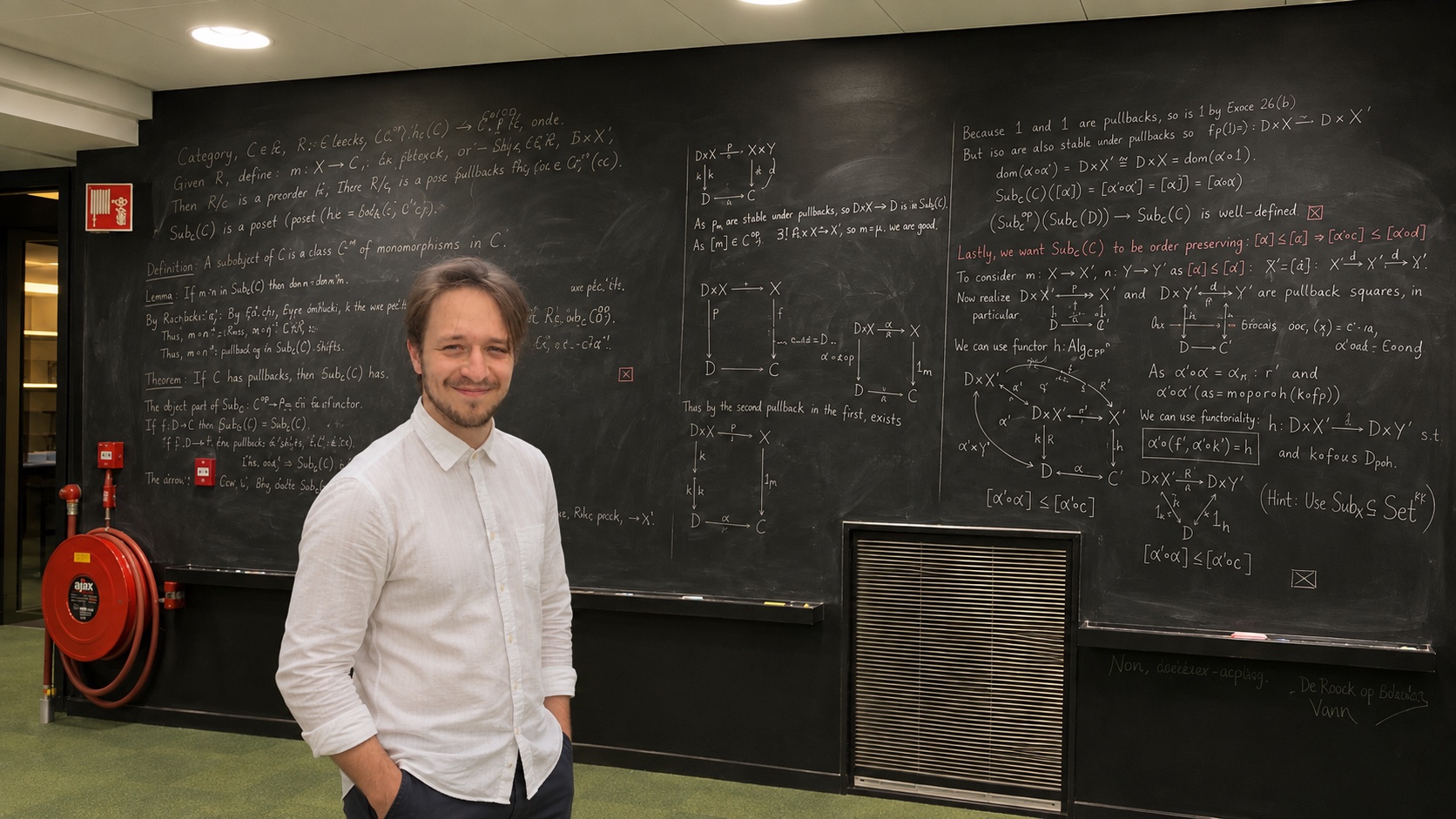
My background is in mathematics, astronomy and theoretical physics. I like helping people cross a mathematical threshold: an exam chapter, an abstract course or a technical argument that suddenly feels like too much at once.
Besides that
Mathematics remains the main subject. The same calm explanation can also help with digital devices and tools, especially when you want to understand what something does and why a particular setting works.
Learning to use ChatGPT or similar AI tools: asking useful questions, privacy, limitations, realistic expectations and calm practice.
macOS workflows, files, installing software, video formats, codecs, subtitles and export settings in practical language.
Especially LG TVs: comparing models, picture and sound settings, connections, apps and a sensible home setup.
Contact
Mention your programme, subject or topic, and where it feels rough: calculation, definition, proof, notation, exam technique, settings, files or overview. Then we can see together how and where tutoring may be useful.